Nikon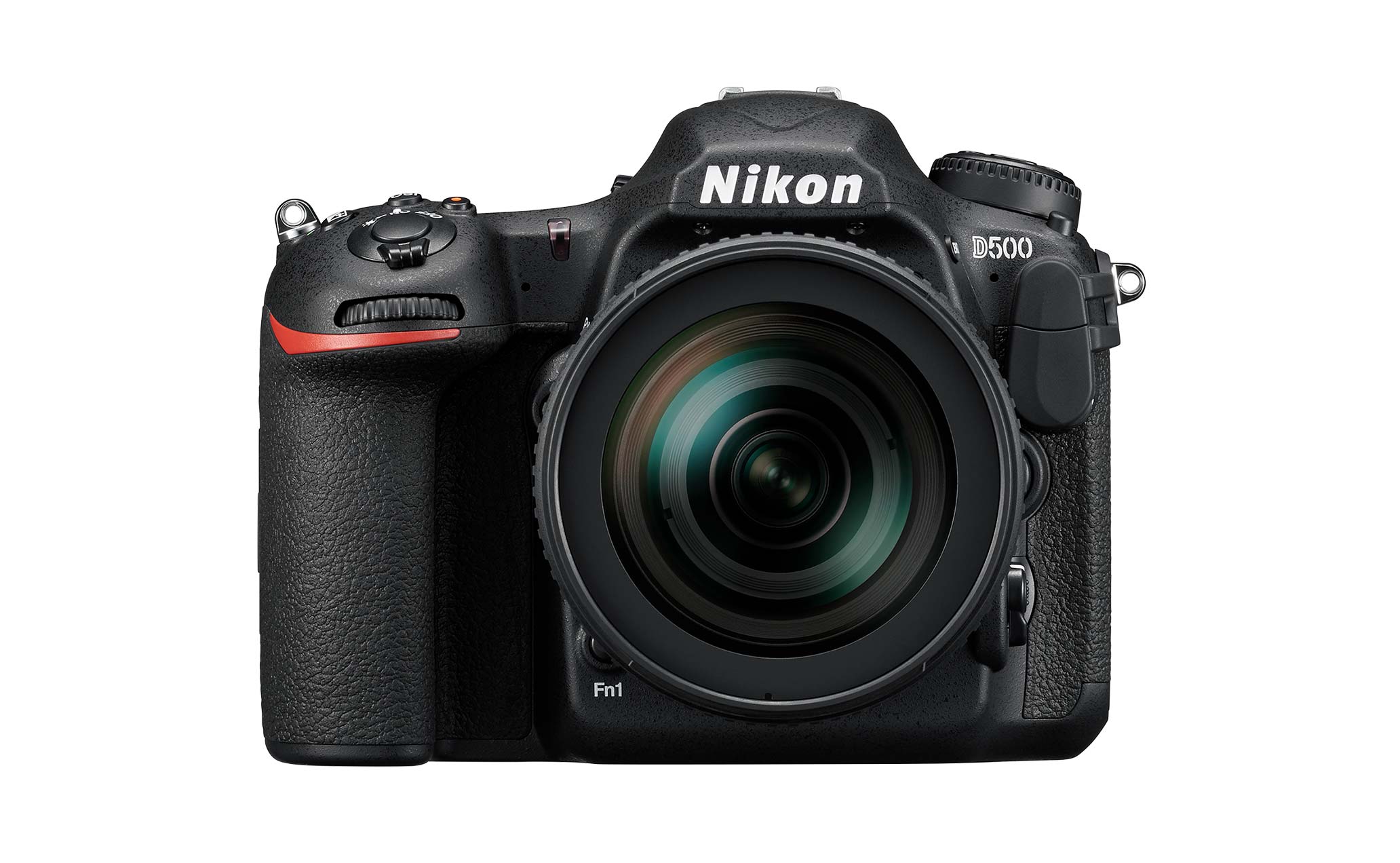
Nikon
Nikon D500
Powerful new 153-point AF system delivers superior subject acquisition performance across a wider range of situations
- Product code
- D500
- Category
- Cameras & Optics
- Family
- DSLR
- Weight
- 0.86 kg
Specifications
Type of camera
- Type
- Single-lens reflex digital camera
- Lens mount
- Nikon F mount (with AF coupling and AF contacts)
- Effective angle of view
- Nikon DX format; focal length in 35 mm [135] format equivalent to approx. 1.5x that of lenses with FX format angle of view
Effective pixels
- Effective pixels
- 20.9 million
Image sensor
- Image sensor
- 23.5 x 15.7 mm CMOS sensor
- Total pixels
- 21.51 million
- Dust-reduction system
- Image sensor cleaning, Image Dust Off reference data (Capture NX-D software required)
Storage
- Image size (pixels)
- DX (24x16) image area: 5568 x 3712 [L], 4176 x 2784 [M], 2784 x 1856 [S]; 1.3x (18x12) image area: 4272 x 2848 [L], 3200 x 2136 [M], 2128 x 1424 [S]; Photographs with image area of DX taken during movie recording: 5568 x 3128 [L], 4176 x 2344 [M], 2784 x 1560 [S]; Photographs with image area of 1.3x taken during movie recording: 4272 x 2400 [L], 3200 x 1800 [M], 2128 x 1192 [S]; Photographs taken during movie recording at a frame size of 3840 x 2160: 3840 x 2160
- File format
- NEF (RAW): 12 or 14 bit (lossless compressed, compressed or uncompressed); large, medium and small available (medium and small images are recorded at a bit depth of 12 bits using lossless compression); TIFF (RGB); JPEG: JPEG-Baseline compliant with fine (approx. 1:4), normal (approx. 1:8) or basic (approx. 1:16) compression; Optimal quality compression available; NEF (RAW)+JPEG: Single photograph recorded in both NEF (RAW) and JPEG formats
- Picture Control system
- Standard, Neutral, Vivid, Monochrome, Portrait, Landscape, Flat; selected Picture Control can be modified; storage for custom Picture Controls
- Media
- XQD, SD (Secure Digital) and UHS-II compliant SDHC and SDXC memory cards
- Dual card slot
- Either card can be used for primary or backup storage or for separate storage of NEF (RAW) and JPEG images; pictures can be copied between cards
- File system
- DCF 2.0, Exif 2.3, PictBridge
Viewfinder
- Viewfinder
- Eye-level pentaprism single-lens reflex viewfinder
- Frame coverage
- DX (24x16) image area: Approx. 100% horizontal and 100% vertical; 1.3x (18x12) image area: Approx. 98% horizontal and 98% vertical
- Magnification
- Approx. 1.0x (50 mm f/1.4 lens at infinity, -1.0 m -1 )
- Eyepoint
- 16 mm (-1.0 m -1 ; from center surface of viewfinder eyepiece lens)
- Diopter adjustment
- -2 to +1 m -1
- Focusing screen
- Type B BriteView Clear Matte Mark II screen with AF area brackets (framing grid can be displayed)
- Reflex mirror
- Quick return
- Depth-of-field preview
- Pressing Pv button stops lens aperture down to value selected by user (A and M modes) or by camera (P and S modes)
- Lens aperture
- Instant return, electronically controlled
Lens
- Compatible lenses
- Compatible with AF NIKKOR lenses, including type G, E and D lenses (some restrictions apply to PC lenses) and DX lenses, AI-P NIKKOR lenses, and non-CPU AI lenses (A and M modes only); IX-NIKKOR lenses, lenses for the F3AF, and non-AI lenses cannot be used; The electronic rangefinder can be used with lenses that have a maximum aperture of f/5.6 or faster (the electronic rangefinder supports 15 focus points with lenses that have a maximum aperture of f/8 or faster, of which 9 points are available for selection)
Shutter
- Type
- Electronically controlled vertical-travel focal-plane mechanical shutter; electronic front-curtain shutter available in mirror up release mode
- Speed
- 1/8000 to 30 s in steps of 1/3, 1/2 or 1 EV, bulb, time, X250
- Flash sync speed
- X=1/250 s; synchronizes with shutter at 1/250 s or slower
Release
- Release mode
- S (single frame), CL (continuous low speed), CH (continuous high speed), Q (quiet shutter-release), QC (quiet continuous shutter-release), Self-timer, MUP (mirror up)
- Approximate frame advance rate
- CL: 1 to 9 fps, CH: 10 fps, QC: 3 fps
- Self-timer
- 2 s, 5 s, 10 s, 20 s; 1 to 9 exposures at intervals of 0.5, 1, 2 or 3 s
Exposure
- Metering
- TTL exposure metering using RGB sensor with approx.180K (180,000) pixels
- Metering method
- Matrix: 3D color matrix metering III (type G, E and D lenses); color matrix metering III (other CPU lenses); color matrix metering available with non-CPU lenses if user provides lens data; Center-weighted: Weight of 75% given to 8-mm circle in center of frame; diameter of circle can be changed to 6, 10 or 13 mm, or weighting can be based on average of entire frame (non-CPU lenses use 8-mm circle); Spot: Meters 3.5-mm circle (about 2.5% of frame) centered on selected focus point (on center focus point when non-CPU lens is used); Highlight-weighted: Available with type G, E and D lenses
- Range (ISO 100, f/1.4 lens, 20°C/68°F)
- Matrix or center-weighted metering: -3 to 20 EV; Spot metering: 2 to 20 EV; Highlight-weighted metering: 0 to 20 EV
- Exposure meter coupling
- Combined CPU and AI
- Mode
- Programmed auto with flexible program (P); shutter-priority auto (S); aperture-priority auto (A); manual (M)
- Exposure compensation
- -5 to +5 EV in increments of 1/3, 1/2 or 1 EV
- Exposure lock
- Luminosity locked at detected value
- ISO sensitivity (Recommended Exposure Index)
- ISO 100 to 51200 in steps of 1/3, 1/2 or 1 EV; can also be set to approx. 0.3, 0.5, 0.7 or 1 EV (ISO 50 equivalent) below ISO 100 or to approx. 0.3, 0.5, 0.7, 1, 2, 3, 4 or 5 EV (ISO 1640000 equivalent) above ISO 51200; auto ISO sensitivity control available
- Active D-Lighting
- Auto, extra high, high, normal, low or off
Focus
- Autofocus
- Multi-CAM 20K autofocus sensor module with TTL phase detection, fine-tuning, and 153 focus points (including 99 cross sensors and 15 sensors that support f/8), of which 55 (35 cross sensors and 9 f/8 sensors) are available for selection
- Detection range
- -4 to 20 EV (ISO 100, 20°C/68°F)
- Lens servo
- Autofocus (AF): Single-servo AF (AF-S); continuous-servo AF (AF-C); predictive focus tracking automatically activated according to subject status; Manual focus (M): Electronic rangefinder can be used
- Focus point
- 153 focus points, of which 55 or 15 are available for selection
- AF-area mode
- Single-point AF, 25-, 72-, or 153-point dynamic-area AF, 3D-tracking, group-area AF, auto-area AF
- Focus lock
- Focus can be locked by pressing shutter-release button halfway (single-servo AF) or by pressing the center of the sub-selector
Flash
- Flash control
- TTL: i-TTL flash control using RGB sensor with approx. 180K (180,000) pixels; i-TTL balanced fill-flash for digital SLR is used with matrix, center-weighted and highlight-weighted metering, standard i-TTL fill-flash for digital SLR with spot metering
- Flash mode
- Front-curtain sync, slow sync, rear-curtain sync, red-eye reduction, red-eye reduction with slow sync, slow rear-curtain sync, off; auto FP high-speed sync supported
- Flash compensation
- -3 to +1 EV in increments of 1/3, 1/2 or 1 EV
- Flash-ready indicator
- Lights when optional flash unit is fully charged; flashes after flash is fired at full output
- Accessory shoe
- ISO 518 hot-shoe with sync and data contacts and safety lock
- Nikon Creative Lighting System (CLS)
- i-TTL flash control, Advanced Wireless Lighting (optical/radio), auto FP high-speed sync, modeling illumination, FV lock, unified flash control, flash color information communication and AF-assist illumination for multi-point AF
- Sync terminal
- ISO 519 sync terminal with locking thread
White balance
- White balance
- Auto (3 types), incandescent, fluorescent (7 types), direct sunlight, flash, cloudy, shade, preset manual (up to 6 values can be stored, spot white balance measurement available during live view), choose color temperature (2500 K to 10000 K), all with fine-tuning
Bracketing types
- Bracketing types
- Exposure, flash, white balance, and ADL
Live view
- Live view mode
- Photo live view, movie live view
- Lens servo
- Autofocus (AF): Single-servo AF (AF-S); full-time-servo AF (AF-F); Manual focus (M)
- AF-area mode
- Face-priority AF, wide-area AF, normal-area AF, subject-tracking AF
- Autofocus
- Contrast-detect AF anywhere in frame (camera selects focus point automatically when face-priority AF or subject-tracking AF is selected)
Movie
- Metering
- TTL exposure metering using main image sensor
- Metering method
- Matrix, center-weighted or highlight-weighted
- Frame size (pixels) and frame rate
- 3840 x 2160 (4K UHD); 30p (progressive), 25p, 24p • 1920 x 1080; 60p, 50p, 30p, 25p, 24p; 1280 x 720; 60p, 50p; Actual frame rates for 60p, 50p, 30p, 25p and 24p are 59.94, 50, 29.97, 25 and 23.976 fps respectively; ★high quality available at all frame sizes, normal quality available at all frame sizes except 3840 x 2160
- File format
- MOV
- Video compression
- H.264/MPEG-4 Advanced Video Coding
- Audio recording format
- Linear PCM
- Audio recording device
- Built-in stereo or external microphone; sensitivity adjustable
- ISO sensitivity
- Exposure modes P, S and A: Auto ISO sensitivity control (ISO 100 to Hi 5) with selectable upper limit; Exposure mode M: Auto ISO sensitivity control (ISO 100 to Hi 5) available with selectable upper limit; manual selection (ISO 100 to 51200 in steps of 1/3, 1/2 or 1 EV) with additional options available equivalent to approx. 0.3, 0.5, 0.7, 1, 2, 3, 4 or 5 EV (ISO 1640000 equivalent) above ISO 51200
- Active D-Lighting
- Extra high, high, normal, low or off
- Maximum length
- 29 min. 59 s
- Other movie options
- Index marking, time-lapse movies, electronic vibration reduction
Monitor
- Monitor
- 8-cm/3.2-in., approx. 2359k-dot (XGA) TFT ve LCD with 170° viewing angle, approx. 100% frame coverage, and manual monitor brightness control
Playback
- Playback
- Full-frame and thumbnail (4, 9 or 72 images) playback with playback zoom, movie playback, photo and/or movie slide shows, histogram display, highlights, photo information, location data display, auto image rotation, picture rating and IPTC information embedding and display
Interface
- USB
- SuperSpeed USB (USB 3.0 Micro-B connector); connection to built-in USB port is recommended
- HDMI output
- Type C HDMI connector
- Audio input
- Stereo mini-pin jack (3.5-mm diameter; plug-in power supported)
- Audio output
- Stereo mini-pin jack (3.5-mm diameter)
- Ten-pin remote terminal
- Can be used to connect optional remote control, WR-R10 (requires WR-A10 WR Adapter) or WR-1 Wireless Remote Controller, GP-1/GP-1A GPS Unit or GPS device compliant with NMEA0183 version 2.01 or 3.01 (requires MC-35 GPS Adapter Cord and cable with D-sub 9-pin connector)
Wireless
- Standards
- IEEE 802.11b, IEEE 802.11g
- Authentication
- Open system, WPA2-PSK
Bluetooth
- Communication protocols
- Bluetooth Specification Version 4.1
NFC
- Operation
- NFC Forum Type 3 Tag
Supported languages
- Supported languages
- Arabic, Bengali, Bulgarian, Chinese (Simplified and Traditional), Czech, Danish, Dutch, English, Finnish, French, German, Greek, Hindi, Hungarian, Indonesian, Italian, Japanese, Korean, Marathi, Norwegian, Persian, Polish, Portuguese (Portugal and Brazil), Romanian, Russian, Serbian, Spanish, Swedish, Tamil, Telugu, Thai, Turkish, Ukrainian, Vietnamese
Power source
- Battery
- One EN-EL15 Rechargeable Li-ion Battery
- Battery pack
- Optional MB-D17 Multi-Power Battery Pack with one EN-EL18a or EN-EL18 Rechargeable Li-ion Battery (available separately), one EN-EL15 Rechargeable Li-ion Battery or eight R6/AA-size alkaline, Ni-MH or lithium batteries; a BL-5 Battery Chamber Cover is required when using EN-EL18a or EN-EL18 battery
- AC adapter
- EH-5b AC Adapter; requires EP-5B Power Connector (available separately)
Tripod socket
- Tripod socket
- 1/4 in. (ISO 1222)
Dimensions / weight
- Dimensions (W x H x D)
- Approx. 147 x 115 x 81 mm/5.8 x 4.6 x 3.2 in.
- Weight
- Approx. 860 g/1 lb 14.4 oz with battery and XQD memory card but without body cap; approx. 760 g/1 lb 10.9 oz (camera body only)
Operating environment
- Operating environment
- Temperature: 0 to 40°C/32 to 104°F; humidity: 85% or less (no condensation)
Accessories
- Supplied accessories (may differ by country or area)
- EN-EL15 Rechargeable Li-ion Battery, MH-25a Battery Charger, DK-17F Fluorine-Coated Finder Eyepiece, UC-E22 USB Cable, USB Cable Clip, HDMI Cable Clip, AN-DC17 Camera Strap, BF-1B Body Cap
